
As a rule, any work that requires a planning permit in Brussels also requires an architect. However, the Order of 13 November 2008 provides exceptions for works that do not usually raise structural issues.
The principle: an architect is required
The CoBAT (Brussels Spatial Planning Code) requires an architect to design and oversee any project that needs a planning permit. The architect draws up the plans, prepares the application file and makes sure the project complies with the regulations.
This requirement protects the applicant and safeguards the planning quality of projects. However, certain simple works are exempt from it.
No permit needed = no architect needed
Key rule: anything that is exempt from planning permission is automatically exempt from the architect requirement. This covers all the works listed on our page on work without a permit in Brussels.
Works that need a permit but no architect
The following works require a planning permit but are exempt from the architect requirement:
- Demolition of ancillary buildings (attached or free-standing) that does not compromise the stability of the buildings that remain
- Putting up fences or a dividing wall between two properties
- Installing antennas, masts, pylons, wind turbines and similar structures (if there is no structural issue)
- Installing satellite dishes or solar panels (if there is no structural issue)
- Building an uncovered swimming pool or sports ground
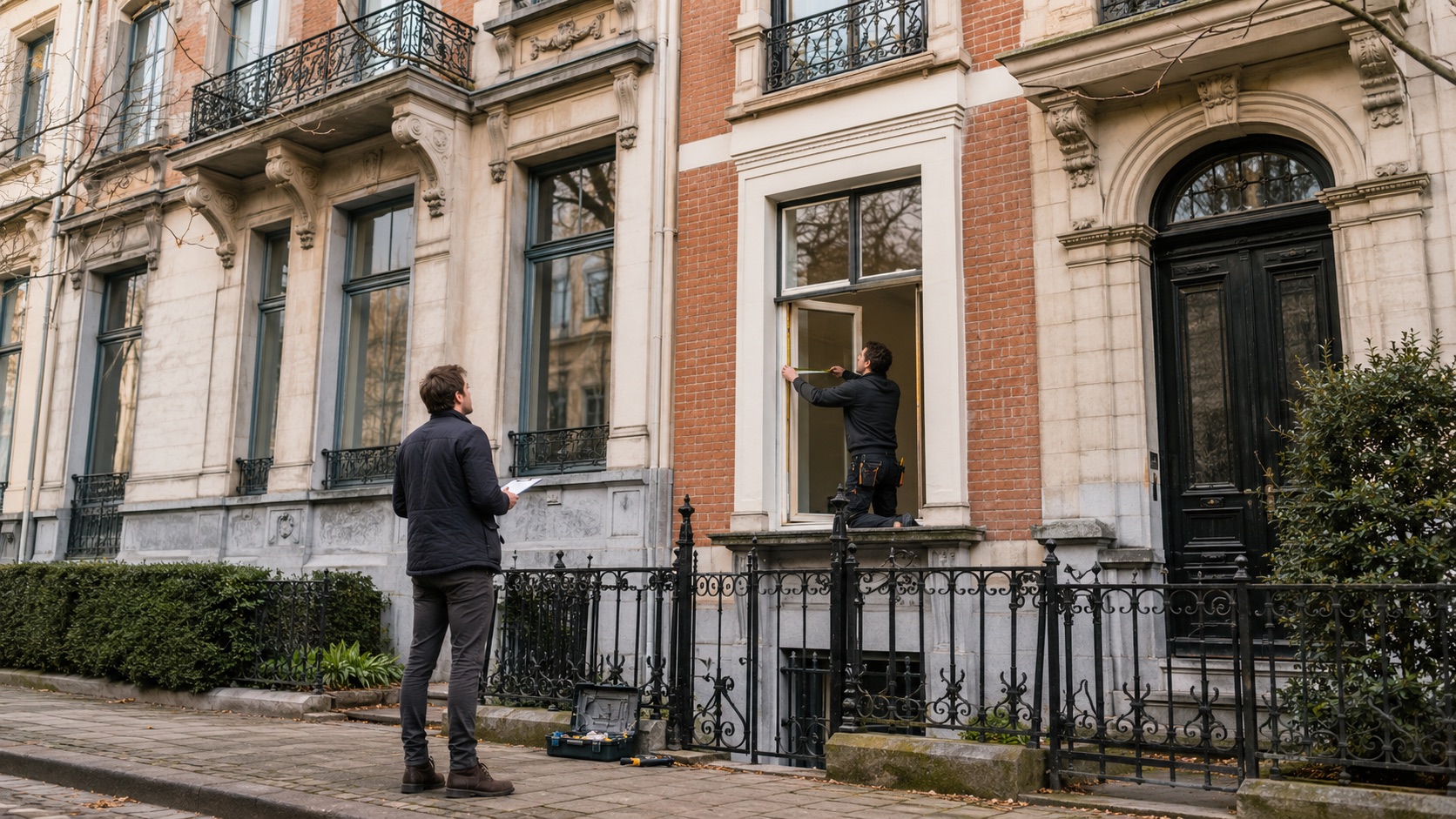
- Altering openings or window frames where this does not raise a structural issue
- Significantly altering the ground level
- Clearing woodland
- Felling tall trees
- Putting up signs or advertising displays
Also exempt: works that could have been exempt from a permit but need one solely because they depart from a planning regulation.
Preparing your application without an architect
Without an architect, it is up to the applicant to prepare the application file. It must contain:
- The completed application form (Annex 1)
- Plans of the existing and proposed situation (dimensioned, to scale)
- Photos of the existing situation
- An explanatory note on the project
- The statistical form
The plans do not need to be signed by an architect, but they must be clear and precise enough for the application to be assessed.
Practical tips
- Consult your municipality: before submitting, book an appointment with the planning department to confirm that your works are indeed exempt from the architect requirement
- Follow the regulations: being exempt from the architect requirement does not exempt you from complying with the RRU (Regional Urban Planning Regulation), the RCU (municipal urban planning regulation) and the PPAS (special land-use plan)
- Stability: if there is the slightest doubt about stability, call in a professional
- Protected heritage sites: specific rules apply to these sites and to buildings in a protection zone